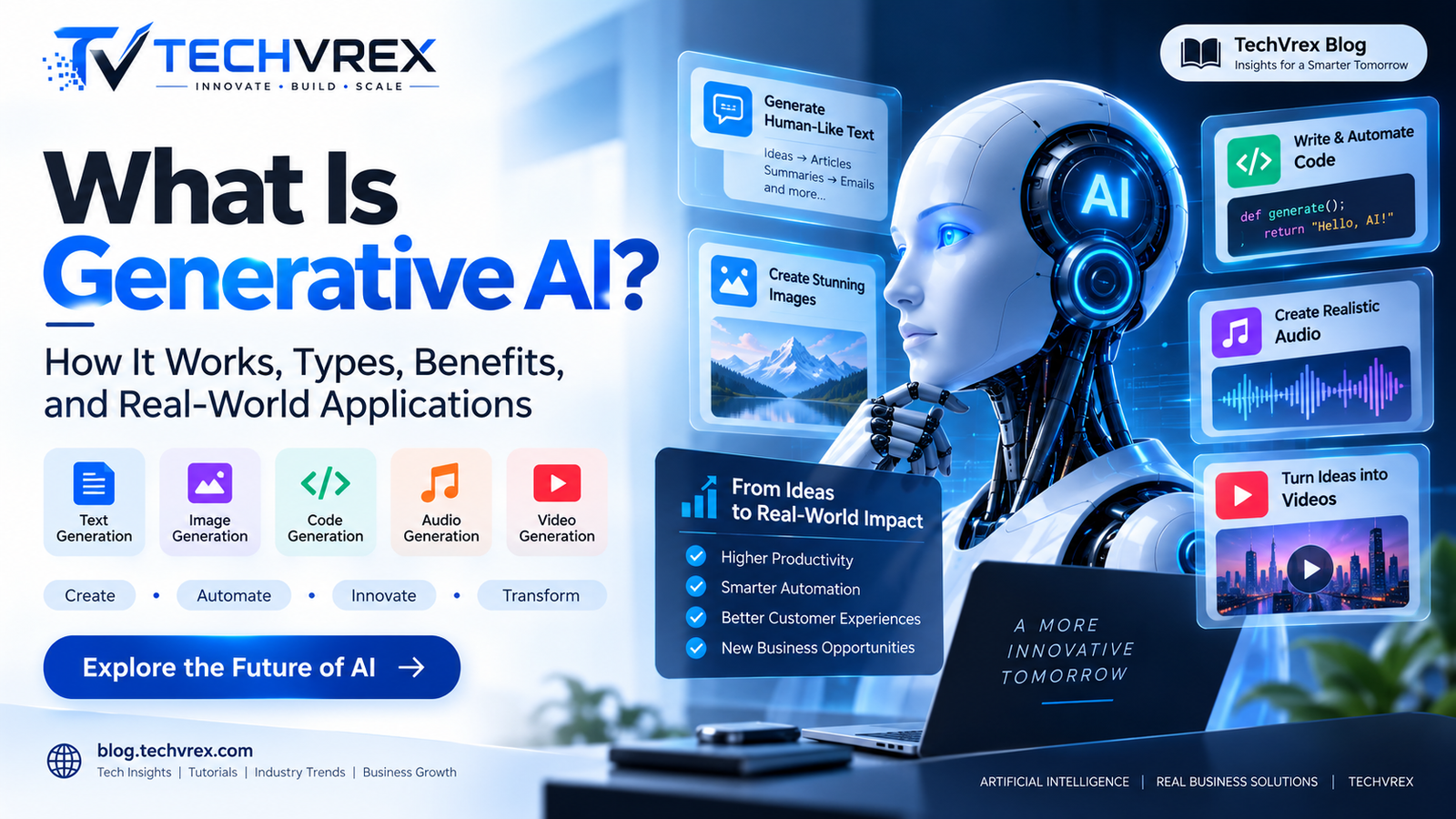
What is generative AI? Generative AI is a type of artificial intelligence that can create new content such as text, images, code, audio, video, and other digital content based on patterns learned from existing data.
Unlike traditional AI systems that are primarily designed to analyze information, classify data, or make predictions, generative AI can produce new outputs in response to a user’s instructions or prompts.
From AI chatbots and coding assistants to content generation and business automation, generative AI is becoming an important technology for organizations across industries.
In this guide, we will explain what generative AI is, how it works, its major types, common applications, benefits, limitations, and how businesses can use it.
What Is Generative AI?
Generative AI is an AI technology that learns patterns from large datasets and uses those patterns to generate new content such as text, images, code, audio, and video.
For example, a generative AI system can take a prompt such as:
“Create a product description for a wireless headphone.”
and generate a new product description based on the instructions.
Generative AI can also summarize documents, write software code, answer questions, generate images, analyze information, and assist with many business processes.
How Does Generative AI Work?
Generative AI systems generally use machine learning models trained on large amounts of data.
The basic process can be understood in four steps:
1. Data Collection
An AI model is trained using large datasets relevant to the type of content it needs to understand.
Depending on the system, the data may contain text, images, audio, video, source code, or other information.
2. Model Training
During training, the model learns statistical patterns and relationships within the data.
For example, a language model learns relationships between words, phrases, concepts, and different forms of language.
3. User Prompt
A user provides an instruction, question, or other input known as a prompt.
For example:
“Explain blockchain technology to a beginner.”
4. Content Generation
The trained model processes the input and generates an output based on the patterns and relationships it learned during training.
The quality of the output depends on factors such as the model, training data, prompt, context, and system design.
What Are the Main Types of Generative AI?
Generative AI is not limited to text generation. Different models can generate different types of content.
1. Text Generation
Text-based generative AI can create:
- Articles
- Summaries
- Emails
- Product descriptions
- Reports
- Chat responses
- Marketing copy
- Documentation
Large language models are commonly used for these applications.
2. Image Generation
Image-generation systems can create images from text descriptions.
For example:
“Create a professional illustration of an AI-powered hospital management system.”
The system can generate an image based on the description.
3. Code Generation
Generative AI can assist developers by producing:
- Source code
- Functions
- SQL queries
- API examples
- Unit tests
- Documentation
- Code explanations
Developers can use these systems as programming assistants, although generated code still needs appropriate review and testing.
4. Audio Generation
Generative AI can create or transform audio, including:
- Synthetic voices
- Voiceovers
- Sound effects
- Music
- Speech-related content
5. Video Generation
Generative AI can also create or modify video content using text, images, or other inputs.
Potential applications include marketing videos, educational content, product demonstrations, and creative media.
Generative AI vs Traditional AI
Generative AI and traditional AI can solve different types of problems.
| Traditional AI | Generative AI |
|---|---|
| Classification | Content generation |
| Prediction | Text generation |
| Detection | Image generation |
| Recommendation | Code generation |
| Data analysis | Creative assistance |
| Pattern recognition | Conversational interaction |
For example, a traditional AI system might determine whether an email is spam.
A generative AI system could instead draft an email response based on the content of an incoming message.
In real-world systems, both approaches can also be combined.
What Are the Benefits of Generative AI?
Generative AI can provide several benefits when implemented appropriately.
Faster Content Creation
AI can help teams produce drafts, summaries, descriptions, documentation, and other content more quickly.
Improved Productivity
Employees can use AI assistants to automate repetitive tasks and spend more time on higher-value work.
Software Development Assistance
Developers can use AI tools to generate code suggestions, explain unfamiliar code, create tests, and assist with debugging.
Customer Support Automation
AI-powered conversational systems can answer common questions and provide automated support around the clock.
Business Process Automation
Generative AI can be integrated into workflows to process information, generate responses, summarize documents, and assist with decision-making.
Personalized Experiences
AI systems can generate responses and recommendations based on user context and available information.
Real-World Applications of Generative AI
Generative AI can be applied across many industries.
Healthcare
Potential applications include:
- Patient communication assistance
- Medical document summarization
- Administrative automation
- Healthcare chatbots
- Clinical workflow assistance
Generative AI used in healthcare requires appropriate privacy, security, validation, and human oversight.
Education
Educational organizations can use generative AI for:
- Personalized learning assistance
- Study materials
- Question generation
- Content summarization
- Educational chatbots
E-Commerce
E-commerce businesses can use AI to generate:
- Product descriptions
- Marketing content
- Customer support responses
- Product recommendations
- Shopping assistants
Finance
Possible applications include:
- Document analysis
- Customer-service assistants
- Report generation
- Internal knowledge assistants
- Workflow automation
Financial applications require appropriate security, governance, and validation.
Software Development
Software companies can use generative AI for:
- Code assistance
- Documentation
- Test generation
- Developer support
- Knowledge retrieval
- AI-powered applications
What Is an AI Chatbot?
An AI chatbot is a software application that uses artificial intelligence to communicate with users through natural language.
Modern AI chatbots can be connected to business knowledge bases, websites, CRMs, databases, APIs, and other software systems.
For example, a business chatbot could:
- Receive a customer question.
- Understand the user’s request.
- Retrieve relevant information.
- Generate an appropriate response.
- Create or update a lead in a CRM.
- Transfer the conversation to a human when required.
This makes AI chatbots useful not only for customer support but also for lead generation and business automation.
What Is RAG in Generative AI?
RAG stands for Retrieval-Augmented Generation.
A RAG system retrieves relevant information from an external knowledge source and provides that information to a generative AI model before generating a response.
A simplified RAG workflow looks like this:
User Question → Information Retrieval → Relevant Context → AI Model → Answer
RAG can be useful when an organization wants an AI assistant to work with its own documents, knowledge bases, product information, or internal data.
What Are the Limitations of Generative AI?
Generative AI is powerful, but it is not perfect.
Incorrect Information
AI models can sometimes generate incorrect or misleading information.
Lack of Context
A model may not understand an organization’s specific processes unless it has access to appropriate context or integrations.
Privacy and Security Risks
Sensitive business or personal information needs to be handled carefully when using AI systems.
Bias
Models can reproduce undesirable patterns or biases present in their training data or system inputs.
Human Oversight
Important business, financial, legal, medical, or security decisions should not automatically depend on AI-generated output without appropriate review.
How Can Businesses Implement Generative AI?
A practical business implementation can follow a structured process:
Step 1: Identify the Business Problem
Start with a specific problem instead of simply deciding to “use AI.”
Step 2: Determine the Required Data
Identify the documents, databases, APIs, customer information, or other sources the AI system needs.
Step 3: Select the AI Architecture
Depending on the use case, the solution may involve an AI API, language model, RAG architecture, fine-tuning, workflow automation, or a combination of technologies.
Step 4: Build the Application
The AI model can be integrated into a website, mobile application, CRM, ERP, chatbot, internal tool, or other software system.
Step 5: Test and Evaluate
The system should be evaluated for accuracy, reliability, security, performance, and cost.
Step 6: Deploy and Monitor
After deployment, organizations should continuously monitor system performance and improve the implementation based on real-world usage.
Generative AI FAQs
Is generative AI the same as artificial intelligence?
No. Generative AI is a subset of artificial intelligence focused on generating new content. Artificial intelligence is a broader field that includes prediction, classification, optimization, computer vision, robotics, natural language processing, and other capabilities.
Can generative AI create original content?
Generative AI can produce new outputs based on patterns learned from its training and the instructions it receives. However, businesses should consider copyright, licensing, originality, and applicable laws when using AI-generated content.
Can generative AI generate software code?
Yes. Generative AI systems can generate and explain programming code, SQL queries, tests, documentation, and other development-related content. Generated code should still be reviewed and tested by qualified developers.
Can generative AI automate customer support?
Yes. AI chatbots and knowledge-based AI systems can automate many repetitive customer-support interactions while escalating complex cases to human agents.
What is RAG in AI?
RAG, or Retrieval-Augmented Generation, combines information retrieval with generative AI. The system retrieves relevant information from a knowledge source and uses that context to generate a response.
Is generative AI useful for small businesses?
Yes. Small businesses can use generative AI for customer support, content creation, lead qualification, internal knowledge management, document processing, marketing assistance, and workflow automation.
Conclusion
Generative AI is changing how organizations create content, interact with customers, develop software, process information, and automate business workflows.
Its value does not come simply from generating text or images. The greater opportunity is integrating AI into real business processes where it can reduce repetitive work, improve productivity, and help organizations deliver better customer experiences.
For businesses considering an AI project, the right starting point is to identify a measurable business problem, determine the required data and integrations, select an appropriate AI architecture, and evaluate the system before scaling it.
Need a Custom AI Solution?
If your business needs a custom AI chatbot, AI automation system, RAG application, AI-powered CRM workflow, or another production-ready AI solution, TechVrex can help design and develop the system around your business requirements.
Explore TechVrex AI Solutions →
https://techvrex.com/services/ai-custom-solutions
Looking for AI chatbot development? →
https://techvrex.com/services/ai-chatbot-development